
If you have ever opened a message and suddenly wondered what three tiny letters mean, you are definitely not alone. Texting language moves incredibly fast, and abbreviations can sometimes make an otherwise simple conversation feel confusing. The IMK meaning in text is especially interesting because it is commonly used to share information while leaving a little room for uncertainty. In most casual online conversations, IMK means In My Knowledge, carrying a meaning close to as far as I know or to my knowledge. Some sources also document a less common interpretation, I Might Know, so the surrounding sentence remains important.
Whether you spotted IMK in a text message, group chat, Instagram DM, Snapchat conversation, TikTok comment, or another online space, understanding the expression can make digital communication feel much easier. This guide explores its meaning, tone, examples, alternatives, social-media usage, common misunderstandings, and practical ways to respond.
What Does IMK Mean in Text?
- IMK most commonly means In My Knowledge in casual digital conversations. 💬
- It usually introduces information that comes from what someone currently knows. 🧠
- The phrase can communicate confidence without claiming complete certainty. 🌿
- A natural replacement is often as far as I know. 😊
- Another close expression is to my knowledge. 🌸
- IMK can make an answer sound softer and less absolute. 🤍
- The abbreviation is mainly associated with informal online communication. 📱
- People may place IMK before the information they are sharing. ✨
- It can also appear after a statement in casual messages. 🌼
- IMK helps someone acknowledge that their information may not be complete. 🫶
- The expression can be useful when facts have not been verified recently. 🔎
- It often communicates personal awareness rather than official confirmation. 📚
- IMK is different from saying I do not know. 🌻
- It can also differ from expressions that communicate personal opinions. 💡
- Context should always guide the interpretation of short internet abbreviations. 🌈
- IMK is generally harmless and informational when used naturally. 🕊️
- Its casual style makes it suitable for friendly conversations. ☀️
- A sentence containing IMK can sound thoughtful rather than overly confident. 🌷
- Understanding the surrounding message usually reveals the intended meaning. 🧩
- The simplest interpretation is usually In My Knowledge. ❤️
The Full Meaning Behind IMK
- The letter I represents the first word in the expression. 🔤
- The letter M represents the word my. 📝
- The letter K represents the word knowledge. 📖
- Together, the initials create the abbreviation IMK. 🔗
- In My Knowledge describes information based on personal understanding. 🌱
- It does not necessarily mean the information has been officially verified. 🛡️
- The phrase leaves room for another person to correct the sender. 🤝
- It can therefore sound modest and conversational. 🌺
- IMK often works like a small uncertainty marker. 🌙
- It tells readers where the information comes from. 🗣️
- The sender is essentially sharing what they currently understand. 🌤️
- The abbreviation can make a statement feel less rigid. 🍃
- It is especially useful when someone is answering from memory. 🧠
- It can also introduce information received from another conversation. 💭
- IMK may help avoid sounding unnecessarily authoritative. 🎈
- Its meaning becomes clearer when substituted with as far as I know. 🔄
- The expression normally relates to knowledge rather than personal preference. ⚖️
- This makes it different from many opinion-based abbreviations. 🌼
- A short abbreviation can still communicate an important social nuance. 💞
- The key idea is personal knowledge with limited certainty. ⭐
IMK Meaning in Chat and Text Messages
- In texting, IMK usually appears in relaxed conversations. 📲
- Friends may use it while discussing plans or schedules. 🗓️
- Someone might write IMK before answering a question. 🙋
- It can introduce information about school, work, travel, or events. 🎒
- A message such as IMK, the meeting starts at nine sounds cautious. ⏰
- The sender believes the information but leaves room for updates. 🔔
- IMK can appear naturally at the beginning of a sentence. 🌅
- It may also appear near the end of a message. 🌙
- Texting punctuation around IMK is flexible. ✍️
- Lowercase imk is common in relaxed typing. 🌿
- Uppercase IMK may appear because of automatic capitalization. 📲
- Neither capitalization style necessarily changes the meaning. 🎯
- The abbreviation saves time during quick conversations. ⚡
- It can help users avoid typing a longer qualifying phrase. 🪶
- IMK can be useful when answering without checking another source. 🔍
- It may signal that the sender is trying to be honest. 🤍
- The expression can soften potentially uncertain information. 🌸
- It is generally more natural in casual than formal writing. 📨
- A full phrase is clearer when the recipient may not know IMK. 🫂
- The IMK meaning in text is easiest to understand from context. 💗
How IMK Is Used in Everyday Conversations

- Friends may use IMK when discussing someone’s plans. 👥
- Students may use it while comparing class information. 🎓
- Coworkers may use it during informal workplace chats. 💼
- Family members may use it when discussing appointments. 🏡
- Someone can use IMK when recalling an old detail. 🗂️
- It can introduce information that sounds familiar but unverified. 🔎
- A person may use it when answering a quick question. 🙌
- It can reduce the pressure of giving a perfect answer. 🌬️
- IMK can communicate helpfulness without pretending to know everything. 🤗
- It can make conversations feel more open to correction. 🌻
- A sender might write IMK, she already left. 🚪
- Another example is IMK, the event begins tomorrow. 🎉
- Someone could say IMK, they changed the deadline. 📅
- The abbreviation can accompany information about locations. 📍
- It can also accompany details about opening times. 🕘
- IMK may appear during discussions about online posts. 🌐
- It can introduce a personal understanding of a situation. 💭
- The tone generally depends on the rest of the message. 🎵
- Friendly wording can make IMK feel reassuring. 🫶
- The surrounding sentence gives the abbreviation its practical meaning. 🧭
IMK as a Way to Express Uncertainty
- IMK often signals that the sender is not claiming absolute certainty. 🌥️
- It can gently communicate I believe this is correct. 💭
- The expression allows room for new information. 🌱
- It can be useful when details may have changed. 🔄
- Someone might use IMK when remembering a previous conversation. 🧠
- It can prevent an uncertain statement from sounding like a fact. 🛡️
- This makes the abbreviation socially useful in casual discussions. 🤝
- IMK can show awareness of personal limitations. 🌾
- It may encourage another person to confirm the information. ✔️
- The sender can remain helpful while acknowledging uncertainty. 💕
- It does not automatically mean the sender is guessing. 🎯
- Instead, the person usually believes they have relevant knowledge. 📚
- The level of certainty depends on the specific context. ⚖️
- A confident message can still contain IMK as a qualification. 🌟
- The abbreviation may sound considerate when information is incomplete. 🌷
- It can make disagreement feel less confrontational. 🕊️
- A cautious phrase may keep a conversation comfortable. ☕
- IMK can show that the sender welcomes correction. 🌈
- This quality makes it useful in everyday digital communication. 💌
- Its uncertainty is usually gentle rather than dramatic. 🌙
IMK Meaning on Social Media
- IMK can appear in comments and direct messages. 📸
- Instagram conversations may use it for casual information sharing. 📷
- Snapchat users may use it in quick replies. 👻
- TikTok comments can contain short forms such as IMK. 🎬
- Group discussions may use it when users exchange information. 👨👩👧👦
- The basic interpretation usually remains In My Knowledge. 🌎
- Social-media context can make abbreviations especially informal. 🫧
- Users often prefer shorter expressions when conversations move quickly. ⚡
- IMK can fit naturally into a short comment. 💬
- It may appear before a correction or clarification. 🔔
- Someone might use it when discussing a viral claim. 🌐
- In that situation, readers should still verify important facts independently. 🔐
- IMK itself does not prove that a statement is accurate. 📌
- It only describes the sender’s current knowledge. 🧠
- Social-media users can interpret abbreviations differently across communities. 🌍
- That is why context remains important. 🧩
- A familiar abbreviation can still have niche meanings elsewhere. 🪴
- When the sentence does not make sense, consider alternative interpretations. 🔄
- Casual online language changes as communities develop. 🌱
- The safest approach is to read the entire conversation. ❤️
IMK Meaning on Snapchat, Instagram, and TikTok
- Snapchat messages often favor quick and compact expressions. 👻
- IMK can fit naturally into a short Snap reply. 💛
- Instagram DMs can use the abbreviation in casual conversations. 📷
- TikTok comments may use IMK when discussing information. 🎥
- The platform itself usually does not change the primary meaning. 🌐
- The relationship between speakers can influence the tone. 🫶
- A close friend may use lowercase imk casually. 😊
- A stranger may use IMK to qualify a claim. 🔎
- A comment can contain IMK before an explanation. 🗯️
- A DM can use it when answering a question. 💌
- Users may combine IMK with other internet abbreviations. 🔤
- Short-form communication often relies heavily on shared context. 🧠
- If you are unfamiliar with IMK, asking for clarification is fine. 🙏
- Social-media abbreviations are not always standardized. 📖
- One community may understand an abbreviation differently from another. 🌍
- A sentence surrounding IMK usually provides useful clues. 🧩
- The subject matter can help determine the intended meaning. 🎯
- The sender’s usual writing habits can also provide context. ✍️
- Avoid assuming a hidden romantic meaning from IMK alone. 💗
- In most cases, it simply qualifies information. 🌸
IMK vs IDK, IMO, and AFAIK
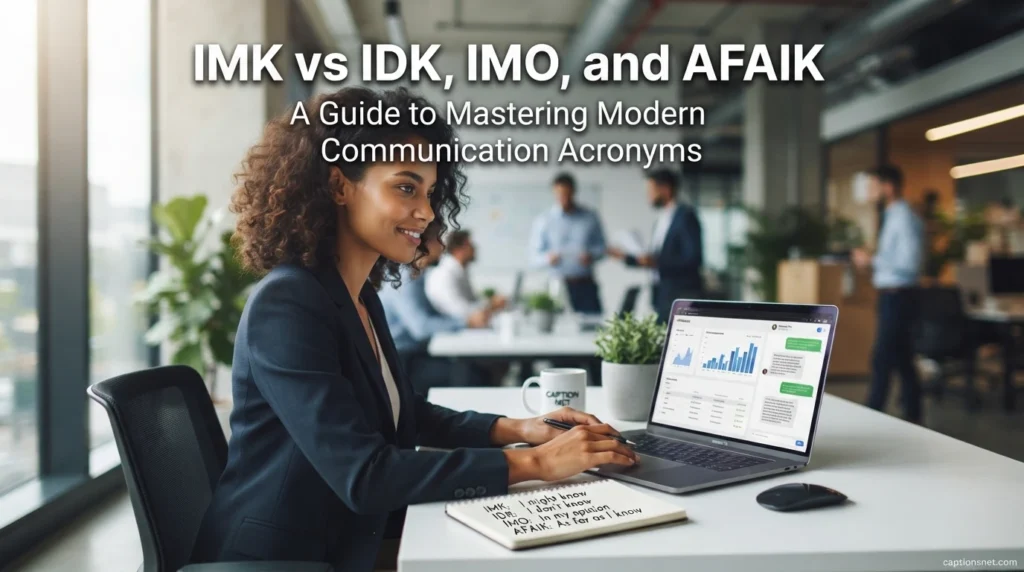
- IMK and IDK communicate very different ideas. 🔀
- IDK means I do not know. ❓
- IMK generally means In My Knowledge. 🧠
- IDK indicates a lack of information. 🌫️
- IMK indicates that the sender has some information to share. 💡
- IMO means In My Opinion. 🗣️
- IMO introduces a personal judgment or preference. ⚖️
- IMK generally introduces information the sender believes they know. 📚
- AFAIK means As Far As I Know. 🔤
- AFAIK is semantically very close to IMK. 🌿
- AFAIK may be more widely recognized by experienced internet users. 🌐
- IMK can feel like a shorter informal knowledge qualifier. ✨
- IDK and IMK can appear in the same conversation. 💬
- One says the person lacks the answer. 🌙
- The other says the person has an answer based on knowledge. 🌞
- IMO focuses on opinion rather than factual awareness. 💭
- Choosing the correct abbreviation can make a message clearer. 🎯
- Readers should avoid treating all three expressions as interchangeable. 🚦
- The surrounding sentence usually reveals which abbreviation fits. 🧩
- Understanding these differences makes online communication easier. ❤️
IMK vs I Might Know
- Some online references list I Might Know as an alternative interpretation. 🔎
- This meaning carries a different grammatical structure. 📝
- I Might Know suggests possible knowledge rather than established knowledge. 🌥️
- In My Knowledge presents information as part of current understanding. 🧠
- I Might Know can sound more tentative. 🍃
- The intended meaning depends heavily on the sentence. 🧩
- If IMK introduces a known fact, In My Knowledge fits naturally. 📚
- If IMK introduces a possible answer, I Might Know may fit. 💡
- The alternative interpretation is less consistently documented. 📖
- Readers should not automatically assume every use means I Might Know. 🎯
- Context is more reliable than isolated letters. 🔐
- The conversation topic can provide useful clues. 🌎
- The grammar around IMK can also reveal intent. ✍️
- A question about knowledge may support the I Might Know reading. ❓
- A factual statement may support the In My Knowledge reading. ✔️
- Different online communities can develop different shorthand habits. 🌱
- When uncertain, asking the sender is perfectly reasonable. 🙏
- Avoid forcing an interpretation that makes the sentence awkward. 🪶
- Short abbreviations can carry multiple community-specific meanings. 🌈
- The primary texting interpretation remains In My Knowledge in many current references. ❤️
Examples of IMK in Real Text Conversations
- IMK, the library closes at six tonight. 📚
- IMK, she already submitted the assignment. 🎓
- IMK, the meeting was moved to Friday. 🗓️
- IMK, they are still accepting applications. 📝
- IMK, the store opens at nine tomorrow. 🛍️
- IMK, he already knows about the change. 👋
- IMK, nobody has canceled the event. 🎉
- IMK, the tickets are still available. 🎟️
- IMK, your package should arrive today. 📦
- IMK, the class begins after lunch. 🍽️
- IMK, they announced the update yesterday. 📢
- IMK, the restaurant closes early on Sundays. 🍽️
- IMK, she moved to another city. 🏙️
- IMK, the deadline is next Monday. ⏳
- IMK, everyone received the email. 📧
- IMK, the website is working again. 💻
- IMK, he plans to attend tonight. 🌙
- IMK, the results have not been posted yet. 📊
- IMK, that rule still applies. 📜
- IMK, this is the latest information I have. 🤍
How to Reply When Someone Says IMK
- You can simply acknowledge the information if it answers your question. 👍
- A response such as thanks works naturally in casual chats. 😊
- You can ask whether the sender has confirmed the information. 🔍
- If accuracy matters, politely request a source. 📚
- You can reply with I will check too when necessary. 🤝
- If the information is helpful, a simple thank-you feels warm. 💕
- If you disagree, calmly explain what you understand instead. 🌿
- You can ask what makes them think the information is correct. 🧠
- A gentle follow-up question can prevent misunderstandings. 🗣️
- You do not need to overanalyze the abbreviation itself. 🌸
- Focus on the actual information in the message. 🎯
- If the sender sounds uncertain, avoid treating the claim as confirmed. ⚠️
- For important matters, verify details independently. 🔐
- You can respond with that makes sense when appropriate. 🌼
- A friendly conversation does not require formal language. ☕
- If you are confused, simply ask what they mean. 🙋
- Asking for clarification is better than guessing incorrectly. 🧩
- You can mirror the sender’s casual tone if comfortable. ✨
- Keep serious decisions based on reliable information rather than slang. 🛡️
- A thoughtful reply keeps the conversation comfortable and clear. ❤️
When Should You Use IMK?
- Use IMK when sharing information from your own knowledge. 🧠
- It works well in casual conversations with friends. 👯
- It can fit naturally into group chats. 💬
- You may use it when answering an informal question. ❓
- It can help qualify information you have not recently checked. 🔎
- IMK is useful when you want to avoid sounding overly certain. 🌿
- It can introduce information remembered from previous discussions. 🗣️
- The abbreviation can work in casual social-media replies. 📱
- It may help make a correction sound gentler. 🌸
- You can use it when another person may know more. 🤝
- IMK can signal openness to correction. 🌈
- It can make your communication feel more transparent. 🤍
- Use it when the recipient understands casual internet shorthand. 💻
- Consider spelling out the phrase for unfamiliar readers. 📝
- Avoid using slang when clarity is especially important. 🎯
- Professional documents generally benefit from standard wording. 💼
- Formal academic writing should normally avoid casual abbreviations. 🎓
- Important instructions should be written clearly and directly. 📋
- Medical, legal, financial, or safety information should be verified independently. 🛡️
- The best use of IMK is relaxed, context-rich communication. 🌷
When Should You Avoid Using IMK?
- Avoid IMK when writing a formal business document. 💼
- Avoid it in academic assignments unless informal language is specifically requested. 🎓
- Avoid unexplained slang when addressing an unfamiliar audience. 👥
- Do not use it when absolute clarity is essential. 🚨
- Important instructions deserve straightforward language. 📋
- Official announcements should generally avoid ambiguous abbreviations. 📢
- Avoid using IMK as proof that a claim is true. 🔐
- The abbreviation only communicates the sender’s knowledge. 🧠
- Do not rely on IMK to verify changing information. 🔄
- Check current schedules before making important plans. 🗓️
- Verify medical information through qualified sources. 🩺
- Confirm financial information before acting on it. 💰
- Double-check legal information before making decisions. ⚖️
- Avoid assuming that every reader understands internet slang. 🌍
- Spell out the phrase when communicating with a broad audience. ✍️
- Avoid unnecessary abbreviations when misunderstandings could cause problems. ⚠️
- Consider using as far as I know for greater clarity. 🌿
- Formal communication benefits from familiar and complete wording. 📖
- Slang should match the relationship and communication setting. 🤝
- When in doubt, choose clarity over brevity. ❤️
Common Misunderstandings About IMK
- Some readers may mistake IMK for another abbreviation. 🤔
- The letters alone do not guarantee one universal interpretation. 🔤
- In most casual text contexts, In My Knowledge is the primary interpretation. 📚
- Some references mention I Might Know as an alternative. 🔎
- IMK does not normally mean I do not know. 🚫
- IMK should not automatically be interpreted as I am okay. 🌱
- It is different from IMO, which means In My Opinion. 💭
- It is different from IDK, which means I do not know. ❓
- It is close in function to AFAIK. 🔗
- Context can change how an abbreviation should be understood. 🧩
- A technical document may use IMK for something unrelated to texting. 💻
- Company or organization initials can create other meanings. 🏢
- A username can also contain the letters IMK. 👤
- Readers should examine the sentence before choosing a definition. 👀
- The sender’s community may have its own shorthand conventions. 🌎
- Confusion is normal because internet slang is constantly evolving. 🌱
- Asking for clarification is a healthy communication habit. 🙏
- An abbreviation does not carry a hidden emotional meaning by itself. 💗
- The surrounding words usually provide the strongest clue. 🧠
- Understanding context makes digital conversations much easier. 🌸
Is IMK Formal or Informal?
- IMK is generally considered informal digital shorthand. 📱
- It fits relaxed texting better than formal writing. 💬
- Friends may use it comfortably in everyday conversations. 😊
- Group chats are a natural environment for short forms. 👥
- Social-media comments can also accommodate casual abbreviations. 📸
- Formal emails usually benefit from spelling out the phrase. 📨
- Academic writing generally favors standard expressions. 🎓
- Professional reports should prioritize clarity and consistency. 💼
- IMK can feel friendly because it resembles conversational speech. ☕
- The lowercase version may appear especially casual. 🌿
- Uppercase letters do not automatically make it formal. 🔠
- The communication setting matters more than capitalization. 🎯
- A formal audience may not immediately recognize IMK. 🤔
- A complete phrase can prevent unnecessary confusion. 📝
- Informal language can strengthen closeness among familiar speakers. 🫶
- Formal contexts usually require language understood by everyone. 🌍
- Choosing between IMK and a full phrase depends on the audience. 👥
- The IMK meaning in text is most useful in casual digital communication. 💡
- Knowing when not to use slang is part of effective communication. 🌟
- Clear language always matters more than saving a few keystrokes. ❤️
FAQs
What does IMK mean in text?
IMK most commonly means In My Knowledge. It is an informal abbreviation people use in texts, chats, and social-media conversations when sharing information based on what they currently know. It is similar to saying as far as I know or to my knowledge.
What does IMK mean on social media?
On social media, IMK generally means In My Knowledge. You may see it in comments, direct messages, group conversations, or replies when someone wants to share information without suggesting that they are completely certain. The exact meaning should always be understood from the surrounding conversation.
Is IMK the same as IDK?
No. IDK means I Don’t Know, while IMK generally means In My Knowledge. IDK tells someone that the sender does not have the answer, whereas IMK suggests that the sender has some knowledge about the subject and is sharing it with a degree of caution.
Is IMK the same as AFAIK?
IMK and AFAIK are similar because both can qualify information based on what the sender knows. AFAIK means As Far As I Know and is a more familiar abbreviation to many internet users. IMK can communicate a similar idea in casual conversations.
Can IMK mean I Might Know?
In some contexts, IMK has been listed as meaning I Might Know. However, In My Knowledge is the more common interpretation in discussions about texting shorthand. If the sentence seems unclear, consider the surrounding words or ask the sender what they intended.
Is IMK formal or informal?
IMK is generally informal and is most appropriate for texting, social media, casual chats, and conversations with people who understand internet abbreviations. For professional emails, academic writing, official documents, or situations where maximum clarity is important, writing the complete phrase is usually preferable.
How should I respond when someone uses IMK?
You can respond naturally based on the information they provide. A simple thanks works when the answer is helpful. If the information is important, you can ask whether they have confirmed it or politely check another reliable source. Because IMK can indicate limited certainty, verification may be useful for important decisions.
Does IMK mean someone is unsure?
It can indicate that the sender is not claiming complete certainty. The phrase usually communicates something like based on what I know or as far as I know. However, using IMK does not necessarily mean the person is guessing; they may simply be acknowledging that their information could be incomplete or outdated.
Conclusion
The IMK meaning in text is usually In My Knowledge, a casual abbreviation used to share information based on a person’s current understanding. It is closely related to phrases such as to my knowledge and as far as I know, making it particularly useful when someone wants to provide an answer without presenting it as absolutely certain.
Learning abbreviations like IMK can make texting, social-media conversations, and online discussions much easier to understand. Although the three letters may look confusing at first, their meaning becomes simple once you consider the surrounding sentence and the context in which they appear.
Remember that internet slang is flexible, and abbreviations can sometimes have alternative meanings within different communities. While In My Knowledge is the common interpretation, context should always be your guide. When accuracy matters, especially with important information, it is wise to verify the details rather than relying solely on an informal message.
Ultimately, knowing what IMK means helps you communicate more naturally and confidently in today’s fast-moving digital world. The next time you come across IMK in a message, you will know that it most likely means In My Knowledge—and you can understand the conversation without missing a beat.