
Have you ever opened a message, scrolled through TikTok, or checked a Snapchat story and suddenly seen “POV” everywhere? Many people feel confused when they encounter internet slang for the first time. Social media platforms move quickly, and new texting abbreviations appear almost daily. If you’re wondering what POV means in chats, captions, videos, and online conversations, you’re not alone.
POV is one of the most popular internet abbreviations used across social media, online messaging apps, and casual texting. While it has a traditional meaning, its usage has evolved significantly thanks to TikTok, Instagram, Snapchat, and Gen Z slang culture. Understanding this social media acronym can help you better interpret content, communicate naturally, and avoid misunderstandings in conversations.
This guide explains everything you need to know about POV, including its exact meaning, how it is used on different platforms, examples in chats, when to use it, alternatives, common mistakes, and frequently asked questions.
What Does POV Mean in Text?
The term pov meaning in text refers to the abbreviation Point of View.
In online messaging and social media, POV is used to indicate a specific perspective, situation, or experience. It tells the audience to imagine themselves in a particular scenario or to view something from a certain angle.
For example:
- POV: You’re walking into school late and everyone looks at you.
- POV: Your best friend finally replies after three days.
- POV: You just finished your final exam.
In these examples, the writer invites readers to imagine themselves experiencing the situation firsthand.
POV has become one of the most recognizable texting slang terms used by younger internet users and content creators.
Origin and Evolution of POV
The phrase “Point of View” existed long before social media. It was commonly used in:
- Literature
- Journalism
- Film production
- Photography
- Storytelling
Traditionally, point of view described the perspective from which a story was told.
As internet culture evolved, users shortened Point of View into POV. The abbreviation spread through online forums, social networking sites, and eventually exploded on TikTok.
Today, POV is considered both an internet abbreviation and a creative storytelling tool. It helps users create relatable content and immersive experiences.
The popularity of POV reflects how social media encourages personal storytelling and audience participation.
POV Meaning on TikTok
TikTok played a major role in making POV mainstream.
On TikTok, POV is usually placed at the beginning of a video caption or displayed as text on the screen. It tells viewers to imagine themselves in a specific situation.
Examples include:
- POV: You’re the new student at school.
- POV: You’re meeting your favorite celebrity.
- POV: You’re living in the year 2050.
- POV: You’re attending your dream wedding.
These videos often use acting, music, and storytelling to create an experience from a particular perspective.
TikTok users frequently use POV to:
- Create relatable scenarios
- Tell short stories
- Make comedy content
- Share emotional experiences
- Build immersive role-play videos
Because of TikTok’s influence, POV has become a major part of modern Gen Z slang.
POV Meaning on Snapchat, Instagram, and WhatsApp
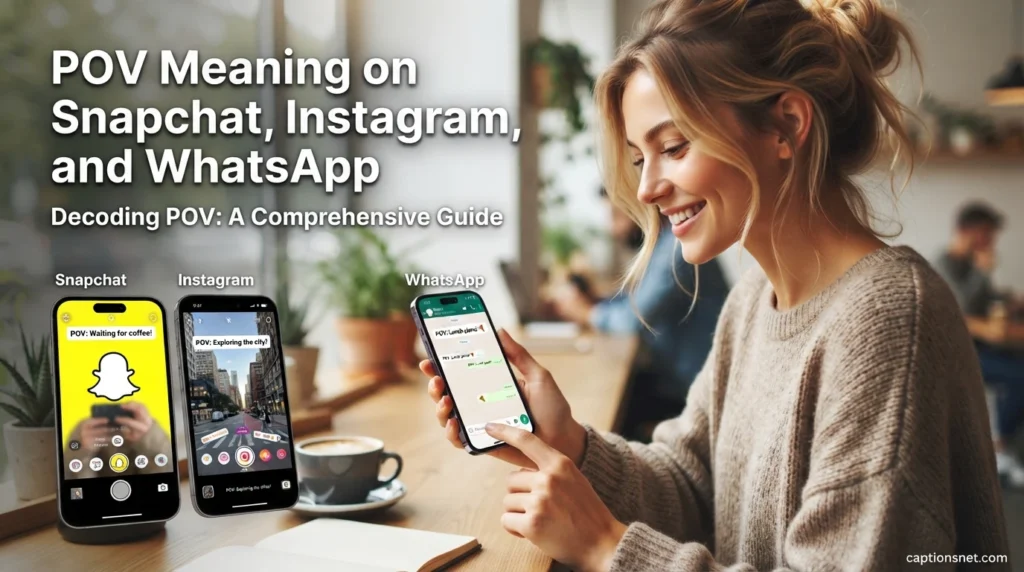
Although the meaning remains largely the same, the way POV is used can vary slightly across platforms.
Snapchat
On Snapchat, POV often appears in:
- Story captions
- Photo descriptions
- Video overlays
Examples:
- POV: You opened my snap instantly.
- POV: We haven’t talked in months.
Snapchat users typically use POV to create humor or relatable moments.
Instagram creators frequently use POV in:
- Reels
- Story posts
- Carousel captions
Examples:
- POV: You’re on vacation with your best friends.
- POV: You finally achieved your goals.
Instagram content often focuses on storytelling and lifestyle experiences.
In WhatsApp chats, POV is less common but still used.
Examples:
- POV: You’re the only one doing work in the group project.
- POV: Your internet stops during an online meeting.
WhatsApp users generally use POV as part of jokes, memes, or casual texting phrases.
How POV Is Used in Text Messages
In everyday online messaging, POV helps people describe a situation from a specific perspective.
Here are some texting examples:
I studied all night.
POV: You’re about to get 100%.
My crush finally texted me.
POV: Best day ever.
Friend 1: I forgot my homework.
Friend 2: POV: Panic mode activated.
POV can make conversations:
- More engaging
- More humorous
- Easier to visualize
- More relatable
This is why it has become a common chat meaning among younger users.
When Should You Use POV?
POV works best when you want someone to imagine a specific situation or perspective.
You can use it when:
- Sharing relatable experiences
- Creating jokes
- Posting social media content
- Writing captions
- Telling mini stories
- Creating role-play scenarios
- Describing emotions
Examples:
- POV: You finally get paid.
- POV: It’s Friday afternoon.
- POV: Your teacher says there’s no homework.
Using POV can make content feel personal and interactive.
Many influencers and creators rely on POV because it encourages audience engagement.
When You Should Not Use POV
Even though POV is popular, there are situations where it may not be appropriate.
Avoid using POV in:
- Professional emails
- Business reports
- Academic assignments
- Formal presentations
- Official workplace communication
For example:
❌ POV: You’re reading this quarterly report.
Instead, formal communication should use direct and professional language.
You should also avoid forcing POV into conversations where it does not naturally fit. Overusing internet slang can make communication feel confusing or repetitive.
Consider your audience before using social media acronyms.
Alternatives to POV in Online Conversations

Sometimes you may want a different phrase that conveys a similar idea.
Popular alternatives include:
- Imagine this
- From my perspective
- Think about this
- Picture yourself
- In this situation
- From your viewpoint
- Scenario
- Let’s say
- Consider this
- Here’s the situation
Examples:
Instead of:
- POV: You’re stuck in traffic.
You could say:
- Imagine being stuck in traffic.
- Picture yourself sitting in traffic.
- Here’s the situation: you’re stuck in traffic.
These alternatives can sound more natural depending on the context.
Common Misunderstandings About POV
Many users misunderstand how POV should be used.
Here are some common mistakes.
Thinking POV Has Multiple Unrelated Meanings
In most texting and social media situations, POV simply means Point of View.
While context may vary, the core meaning remains the same.
Assuming POV Is Only TikTok Slang
Although TikTok helped popularize it, POV existed long before TikTok and is widely used across different platforms.
Using POV Incorrectly
Sometimes creators write captions that do not actually represent a perspective.
Correct:
- POV: You’re entering your first job interview.
Less accurate:
- POV: I went to the store today.
The first example places the audience inside the scenario, while the second simply describes a personal action.
Confusing POV With Personal Opinion
Some people mistakenly think POV means opinion.
In reality, POV refers to perspective or viewpoint rather than an individual opinion.
Understanding this distinction helps avoid confusion in online communication.
Why POV Is So Popular Among Gen Z
Gen Z users helped transform POV into one of the internet’s most recognizable social media terms.
Several factors explain its popularity:
- It creates instant engagement.
- It encourages imagination.
- It supports storytelling.
- It works well in short-form videos.
- It makes content relatable.
- It increases audience participation.
Social media algorithms often reward engaging content, and POV naturally invites viewers to become part of the experience.
As a result, POV remains a major part of modern texting slang and social media culture.
FAQs
What does POV stand for in texting?
POV stands for Point of View. It describes a specific perspective or situation that the audience is meant to imagine experiencing.
Is POV a social media acronym?
Yes. POV is widely recognized as a social media acronym used on TikTok, Instagram, Snapchat, WhatsApp, and other online platforms.
What does POV mean on TikTok?
On TikTok, POV usually introduces a scenario where viewers imagine themselves as part of the story or situation shown in the video.
Is POV considered Gen Z slang?
Yes. While Point of View is an older phrase, its modern social media usage is strongly associated with Gen Z slang and internet culture.
Can POV be used in text messages?
Absolutely. People often use POV in chats to make jokes, tell stories, or create relatable scenarios.
Does POV always mean Point of View?
In most online messaging and social media contexts, yes. Point of View is the standard and most widely accepted meaning.
Is POV formal or informal?
POV is generally informal. It is best suited for casual texting, social media posts, and online conversations.
Why do influencers use POV?
Influencers use POV because it helps create immersive content, increases engagement, and encourages viewers to relate personally to the scenario being presented.
Conclusion
POV stands for Point of View and is one of the most widely used internet abbreviations in modern digital communication. Whether you see it on TikTok, Snapchat, Instagram, WhatsApp, or other social media platforms, the purpose is usually the same: to place the audience inside a specific situation or perspective.
As texting slang continues to evolve, understanding terms like POV helps users navigate online messaging more confidently. From funny memes and relatable videos to creative storytelling and casual texting phrases, POV has become a key part of internet culture. Knowing how and when to use it can make your conversations more engaging while helping you better understand the content you see every day online.